Noisy Lifters
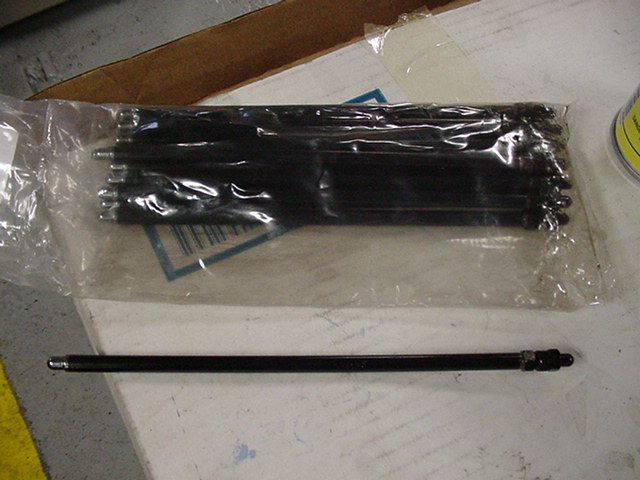
| While talking with Bob Walker at Hot Heads, he suggested a set of adjustable push rods should take care of the lifter clacking. Since we had eliminated oil pressure as a problem, and since hydraulic lifters seldom all fail at the same time, Bob thought I might have some problem that put the lifters outside of their adjustment range. I supplied him with the measurement of the push rods in the engine (9.584") and he built a set of adjustable rods. By the way, on the 354 poly engine, the intake and exhaust push rods are the same length. On the hemi 331 354 and 392, they are different. |
|
||||||||||||||||||||||||||
| A series of nuts and threads provides the adjustment and locking. | 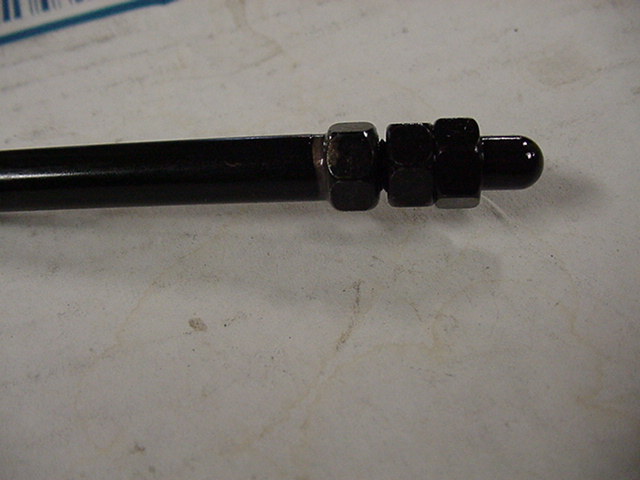
|
||||||||||||||||||||||||||
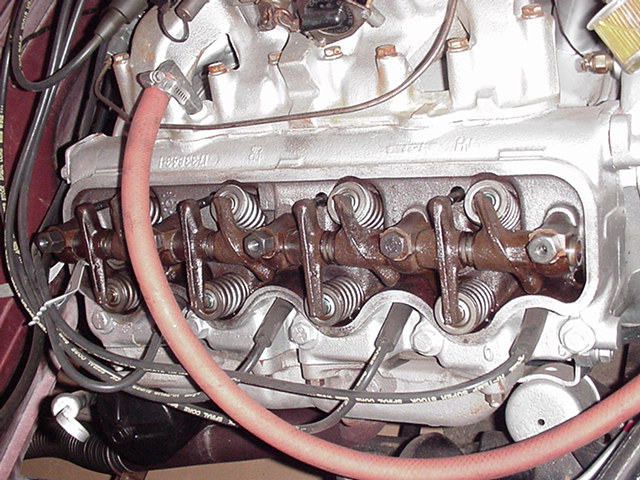
| I started replacing push rods on the driver's side. Bob suggested we adjust the rod until it stops spinning freely and then add one quarter turn. It turns out this is easy enough to do on the upper row of push rods (exhaust) but nearly impossible to do on the lower row (intake) due to access. |
|
||||||||||||||||||||||||||
| Well, you have to start somewhere so I adjusted a few exhaust push rods on the driver's side as Bob instructed, removed them, measured them and took an average of 9.662". I repeated the procedure on the passenger head and the 4 exhaust push rods came out 9.506", 9.532", 9.563", 9.512". I was surprised they were all much shorter than the driver's side. | |||||||||||||||||||||||||||
|
I ran a compression test, adjusted push rod length, ran another compression test and ended up with this:
Passenger side results from second test with adjustable push rods set shorter:
The first number is the length of the push rod as removed from the initial installation. The second number is the rod adjusted for the second try. We wanted to go shorter on all of them to be sure they were seating but not so short we had clacking. With these new lengths on the passenger side all cylinders fire, there is no clacking from any lifter, all exhaust rods can rotate by fingers, and intakes rotate as well but perhaps not as easy due to limited access. This side is done.
|
| ||||||||||||||||||||||||||
|
Driver side results from second test with shortened push rods:
In this configuration, all cylinders are firing and we have one, maybe two clacking lifters. However, the engine is still not running right and I'm afraid it is time to tear into the engine. In the meantime, we are detailing the carb. |
|||||||||||||||||||||||||
To the carb.